Automate the Workflows That Slow Your Business Down
Turn repetitive, manual business processes into structured workflows that move information, tasks, approvals, and actions forward with less manual effort.
We identify where processes can be simplified, connected, and automated using the systems your business already relies on.
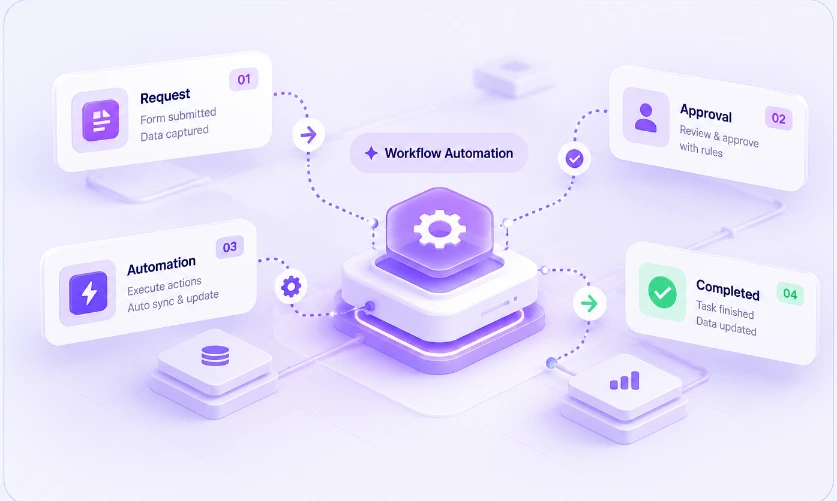
Manual Processes Create Friction That Adds Up
Every day, teams spend valuable hours chasing approvals through email threads, updating multiple spreadsheets, re-entering data between tools, and manually assigning operational tasks.
These micro-delays compound into missed deadlines, fulfillment bottlenecks, inconsistent records, and costly administrative overhead.
By structuring and automating your core operational workflows, tasks move forward automatically, status is immediately visible, and staff can focus on high-impact decisions.
Process Modernization Pipeline
Automate the Steps Your Teams Repeat Every Day
Eliminate operational friction through purpose-built workflow automation solutions.
Approval Workflows
Automatically route requests to the right people, track decisions, and trigger the next step without manual follow-up.
Request Management
Structure internal or external requests with custom forms, assignments, status tracking, notifications, and escalation.
Data Entry & Sync
Reduce repetitive data entry by moving information between systems and databases automatically.
Notifications & Follow-Ups
Automate reminders, alerts, status updates, SLA escalations, and routine communications.
Task Assignment
Automatically create, assign, prioritize, and track team tasks based on business rules or operational events.
Scheduled Processes
Automate recurring checks, scheduled reports, batch data updates, and operational activities.
From Manual Process to Automated Workflow
Automation should simplify the process, not simply make a complicated process run faster.
Understand
Document the current process, people involved, systems used, decisions, and manual steps.
Simplify
Identify unnecessary steps, duplicate work, bottlenecks, and opportunities to improve before automating.
Design
Define the workflow, rules, approvals, responsibilities, triggers, and expected outcomes.
Automate & Validate
Implement the automation, connect the required systems, and test real business scenarios.
Monitor & Improve
Track how the workflow performs and continuously improve it as business requirements change.
From Manual Work to Connected Workflows
How structuring business processes transforms everyday operational efficiency:
Fragmented & Manual
Connected & Automated
"The goal is not to remove people from the process. It is to remove unnecessary manual work so people can focus on the decisions and activities that actually require them."
Where Process Automation Can Make a Difference
Proven business areas where automated workflows drive measurable operational value:
Employee Requests
Automate request submission, routing, approval, notifications, and status tracking across HR and admin.
Sales Operations
Automate lead assignments, pipeline follow-ups, contract notifications, and routine CRM activities.
Finance Workflows
Automate expense approvals, invoice document routing, payment reminders, and recurring reconciliation.
Service Operations
Automate support ticket routing, task assignment, escalations, notifications, and client status updates.
Procurement Workflows
Automate purchase requests, multi-tier approvals, vendor quote comparisons, and dispatch alerts.
Operations & Administration
Automate repetitive internal workflows, scheduled system checks, data syncs, and operational reporting.
Automation Across the Systems Your Business Already Uses
Automating processes seamlessly across your existing software and communication channels:
ERP Platform
CRM System
Web Portals
Email & Chat
Documents
Business Apps
Automation Layer
Rules · Routing · Validation · Triggers
Tasks & Updates
Automation Designed Around the Business Process
Process First
We understand the existing workflow before deciding what should be automated.
Practical Automation
We focus on processes where automation creates real operational value.
Connected Systems
We consider how the workflow interacts with ERP, CRM, APIs, applications, and other systems.
Continuous Refinement
We can refine and extend automated workflows as your business evolves.
Built for Businesses Ready to Reduce Manual Work
Tailored for teams looking to streamline repetitive tasks and manual handoffs:
Repetitive Task Overhead
Teams spending too much valuable time on repetitive manual data entry and routine admin work.
Email-Dependent Approvals
Critical sign-offs stalling due to reliance on unorganized email threads and manual follow-ups.
Duplicate System Entry
Data being repeatedly re-typed or copied across multiple disconnected software tools.
Untracked Requests
Customer or internal department requests lacking transparent visibility and status tracking.
Routine Update Drain
Staff spending excessive hours sending repetitive status notifications, reminders, and updates.
Too Many Manual Handoffs
Business processes delayed by too many fragmented handoffs between teams and departments.
Have a Process That Could Work Better?
Tell us about the repetitive work, approvals, manual handoffs, or workflow bottlenecks your team deals with. We'll help you identify where automation can make a practical difference.