Connect Applications Through Reliable APIs
Design and build APIs that allow applications, platforms, and business systems to exchange data and work together reliably.
From new API development to integrating existing services, we help create the connectivity layer behind modern business applications.
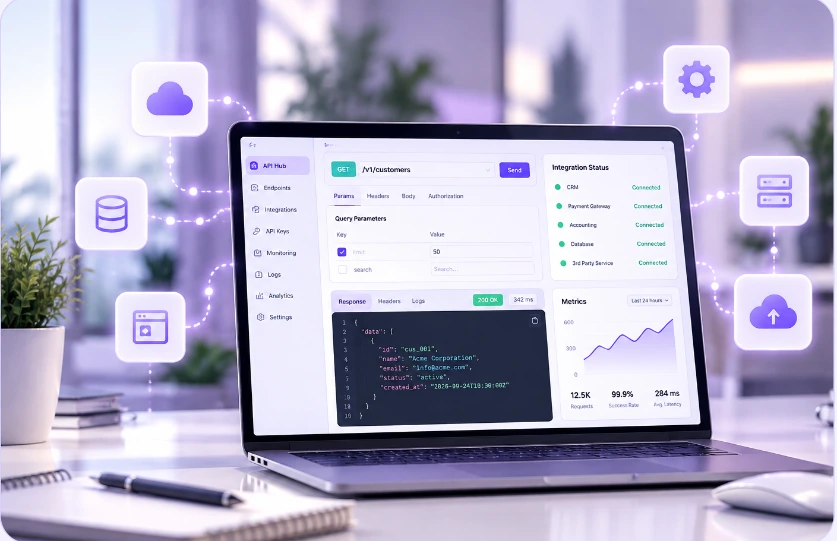
Applications Need a Reliable Way to Communicate
Modern enterprises operate across multiple platforms, including web apps, mobile tools, ERPs, CRMs, and payment gateways. Without structured connectivity, businesses suffer from data silos, error-prone manual exports, and disconnected processes.
Manual data re-entry creates duplicate records, delays in fulfillment, and poor visibility across operational departments.
APIs provide a standardized, secure, and resilient mechanism for systems to exchange real-time information, trigger automated workflows, and scale alongside business growth.
API Connectivity Pipeline
API Development Built Around Your Systems
Robust, secure, and maintainable integration engineering tailored to your operational ecosystem.
Custom API Development
Build APIs for applications and business systems that need to expose or consume structured data and functionality.
Third-Party API Integration
Connect applications with external services, platforms, payment processors, and SaaS APIs.
System-to-System Integration
Connect internal business applications, ERP, CRM, databases, and operational platforms.
Data Synchronization
Create reliable data exchange between systems where information needs to remain aligned.
Authentication & Access
Implement appropriate authentication, authorization, token encryption, and access controls for API-based communication.
API Maintenance & Growth
Monitor, maintain, troubleshoot, and extend APIs as systems and business requirements evolve.
From Data Requirements to Reliable Integration
We start by understanding what systems need to communicate, what information needs to move, and what the business process should achieve.
Understand
Identify the systems, users, data structures, business process, and integration requirement.
Define
Define endpoints, data structures, authentication protocols, workflows, and expected behavior.
Build
Develop the API or integration layer, establish connectors, and configure data validation.
Test & Validate
Test data exchange, authentication, errors, rate limits, edge cases, and real business scenarios.
Monitor & Improve
Maintain the integration, monitor issues, track uptime, and improve it as systems evolve.
Built for Reliable System-to-System Communication
Core technical criteria that ensure enterprise-grade reliability and security:
Clear Data Exchange
Systems should exchange the right information in a structured, typed, and predictable format.
Secure Access
API communication should use appropriate OAuth2, API tokens, and authorization mechanisms.
Reliable Processing
Integrations should account for network retries, failure queues, and graceful exception handling.
Consistent Information
Data should move between systems without creating unnecessary duplication or schema conflicts.
Scalable Connectivity
The integration should easily evolve as transaction volume, endpoints, and data payloads grow.
Maintainability
APIs and integrations should be clearly documented, observable, and practical to support long term.
Where API Development Can Connect Your Business
Practical integration scenarios connecting data pipelines across platforms:
ERP & CRM
Exchange customer, sales, product, financial, or operational information seamlessly between core systems.
Web & Mobile Applications
Connect front-end interfaces with business logic, cloud databases, authentication, and backend services.
E-Commerce
Connect online stores, marketplaces, inventory feeds, orders, customer accounts, and logistics partners.
Payment Services
Connect payment gateways, recurring subscriptions, and reconciliation services directly with business records.
External Business Platforms
Connect third-party SaaS platforms, industry portals, and specialized partner applications through structured APIs.
Internal Applications
Allow distinct internal departments, services, and operational databases to exchange information securely.
One Business Process. Multiple Systems. One Connected Flow.
A centralized API layer ensuring cohesive data transformation and communication across all endpoints:
Web App
Mobile App
CRM System
ERP Platform
Payment Gateways
Third-Party APIs
API Gateway
Auth · Validation · Routing · Transform
Unified Data
Integration With the Business in Mind
Process Understanding
We understand what the integration needs to achieve before deciding how systems should communicate.
Practical Architecture
We choose an integration approach appropriate to the systems, requirements, and expected scale.
Security & Reliability
We consider authentication, data handling, validation, errors, and reliability as part of the integration.
Long-Term Support
We can maintain, troubleshoot, extend, and improve integrations as your technology environment evolves.
Built for Businesses With Multiple Systems
Tailored for organizations requiring seamless data interchange across their tech stack:
Multi-App Data Exchange
Multiple applications and services need to exchange operational records without latency.
Connecting Legacy Systems
Existing core systems need to connect cleanly with modern cloud or web applications.
Eliminating Manual Transfers
Manual CSV imports, exports, and spreadsheet transfers need to be fully automated.
New App Backend Connectivity
A newly built web or mobile application needs a secure, well-structured API backend.
Third-Party SaaS Integrations
External vendor services, payment tools, or CRMs need to feed data into internal systems.
Enterprise Process Automation
Cross-department workflows require reliable, event-driven API communication to run end-to-end.
Need to Connect Your Systems?
Tell us which applications, platforms, or business systems need to communicate. We'll help you determine a practical API and integration approach.