
Spreadsheets have been a trusted business tool for decades. They are flexible, inexpensive, and easy to use for managing data. In the early stages of a business, spreadsheets can effectively handle tasks such as tracking sales, inventory, expenses, and customer information.
However, as a business grows, spreadsheets often become a bottleneck rather than a solution. Multiple versions of the same file, manual data entry, reporting delays, and frequent errors can slow down operations and impact decision-making.
If your team spends more time managing data than using it, it may be time to consider an Enterprise Resource Planning (ERP) system.
Here are seven clear signs that your business has outgrown spreadsheets.
What is the biggest sign that a business has outgrown spreadsheets?
The biggest sign is when employees spend significant time manually entering, reconciling, and correcting data across multiple spreadsheets, leading to errors, reporting delays, and reduced productivity.
In This Article
- Your Team Is Entering the Same Data Multiple Times
- Information Is Spread Across Multiple Files
- Reporting Takes Too Long
- Inventory Management Is Becoming Difficult
- Departments Operate in Silos
- Business Growth Feels Harder Than It Should
- Errors Are Costing Your Business Money
- How an ERP System Solves These Challenge
1. Your Team Is Entering the Same Data Multiple Times
One of the most common signs of operational inefficiency is duplicate data entry.
For example, sales information may be entered into one spreadsheet, inventory updates into another, and accounting records into a third. Every manual entry increases the risk of mistakes and consumes valuable employee time.
An ERP system eliminates redundant work by maintaining a single source of truth. Information entered once becomes available across relevant departments automatically.
Impact:
- Increased administrative workload
- Higher risk of human error
- Inconsistent records between departments
2. Important Information Is Spread Across Multiple Files
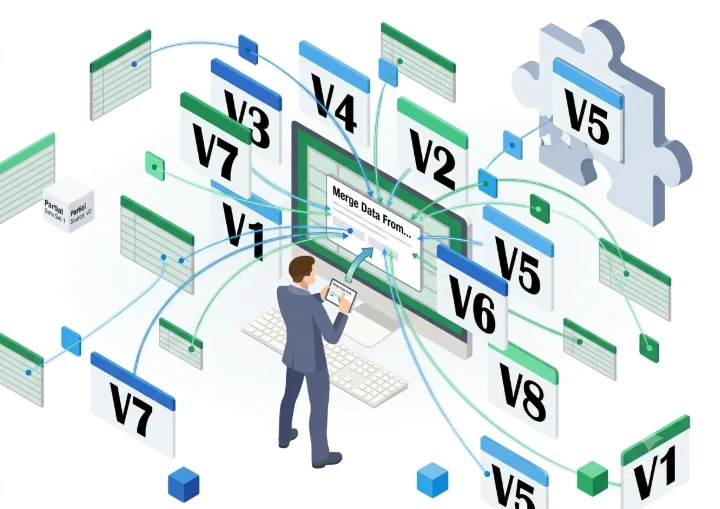
Many growing businesses rely on dozens or even hundreds of spreadsheets stored across different computers, shared drives, or cloud folders.
When employees cannot easily find the latest version of a document, confusion follows. Teams may work with outdated information, resulting in incorrect decisions and unnecessary delays.
An ERP centralizes business information in a unified platform, ensuring everyone accesses the same real-time data.
Impact:
- Version control problems
- Lost productivity
- Difficulty maintaining data accuracy
3. Reporting Takes Too Long
Business leaders need timely information to make informed decisions. If generating reports requires manually collecting data from multiple spreadsheets, valuable time is being lost.
Many businesses spend hours or even days preparing monthly reports because data is scattered across departments.
ERP systems generate real-time dashboards and automated reports, giving decision-makers instant visibility into business performance.
Impact:
- Delayed decision-making
- Reduced business agility
- Limited operational visibility
4. Inventory Management Is Becoming Difficult
Inventory tracking becomes increasingly complex as product lines, warehouses, and transaction volumes grow.
Spreadsheets often struggle to provide accurate stock levels, resulting in:
- Overstocking
- Stock shortages
- Fulfillment delays
- Customer dissatisfaction
An ERP system continuously updates inventory records as purchases, sales, and transfers occur, providing accurate stock visibility at all times.
Impact:

- Inventory inaccuracies
- Higher carrying costs
- Missed sales opportunities
5. Departments Operate in Silos
When sales, finance, purchasing, operations, and customer service use separate tools and spreadsheets, collaboration becomes challenging.
Teams often spend time requesting information from one another instead of focusing on value-generating activities.
ERP systems connect departments through shared processes and centralized data, improving communication and efficiency.
Impact:
- Poor collaboration
- Slower workflows
- Inconsistent customer experiences
6. Business Growth Feels Harder Than It Should
Growth should create opportunities, not operational chaos.
If every new customer, employee, product, or transaction significantly increases administrative workload, your systems may not be scalable.
Spreadsheets typically require additional manual effort as businesses expand. ERP systems are designed to support growth by automating processes and standardizing operations.
Impact:
- Scaling challenges
- Increased operational complexity
- Higher labor costs
7. Errors Are Costing Your Business Money
Even small spreadsheet mistakes can have significant consequences.
Incorrect formulas, accidental deletions, duplicate records, and outdated information can lead to:
- Financial losses
- Incorrect customer orders
- Compliance issues
- Poor strategic decisions
ERP systems reduce dependency on manual processes and provide controls that improve data accuracy and accountability.
Impact:
- Financial risk
- Compliance concerns
- Reduced customer trust
How an ERP System Solves These Challenges
An ERP system brings together core business functions into a single integrated platform.
Instead of relying on disconnected spreadsheets and software applications, businesses can manage operations from one centralized system.
Key benefits include:
- Real-time business visibility
- Automated workflows
- Improved data accuracy
- Faster reporting
- Better inventory control
- Enhanced collaboration
- Greater scalability
With accurate information available across the organization, teams can focus on growth, customer service, and strategic initiatives rather than administrative tasks.
Why Many Businesses Choose Odoo ERP
Modern ERP solutions have become more accessible than ever. Among them, Odoo stands out because of its flexibility, modular design, and ability to support businesses of different sizes.
Organizations can start with the applications they need today and expand their ERP environment as their requirements evolve.
Whether managing sales, accounting, inventory, purchasing, manufacturing, projects, or customer relationships, Odoo provides a connected ecosystem that supports business growth.
Final Thoughts
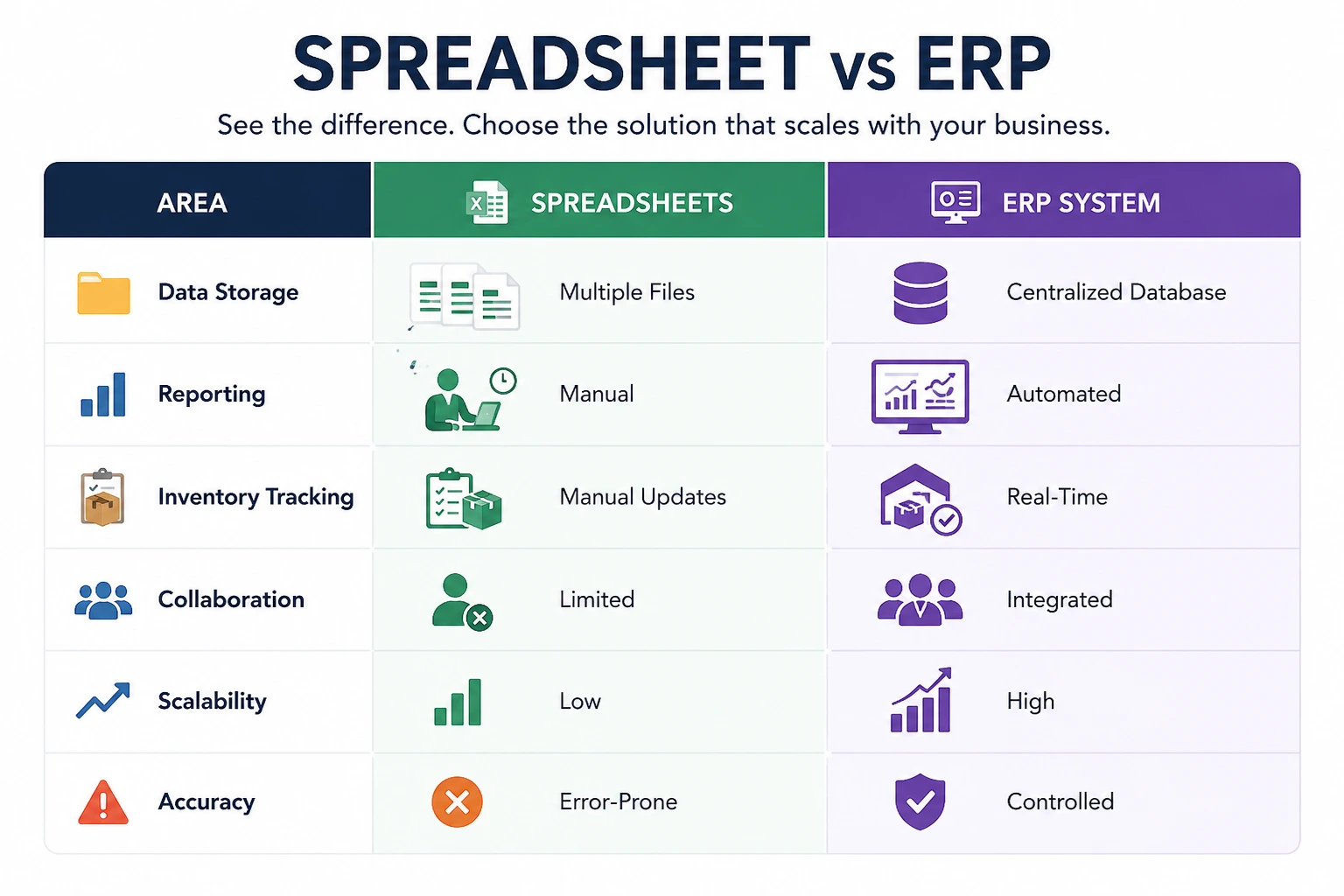
Spreadsheets remain useful tools, but they were never designed to run complex and growing businesses.
If your organization is experiencing duplicate data entry, reporting delays, inventory issues, disconnected departments, or costly errors, these are strong indicators that it may be time to move beyond spreadsheets.
Investing in the right ERP system can streamline operations, improve visibility, and create a foundation for sustainable growth.
The question is no longer whether your business can manage with spreadsheets it is whether spreadsheets can keep up with your business.
Frequently Asked Questions
Yes. Modern ERP solutions such as Odoo are designed for businesses of all sizes and can be implemented gradually as requirements grow.
A business should consider ERP when manual processes, reporting delays, inventory issues, or data inconsistencies begin affecting efficiency and growth.
The cost depends on business size and requirements. However, many organizations find that ERP delivers long-term savings through automation and improved efficiency.
Odoo offers a modular approach, allowing businesses to start with essential applications and expand as needed while maintaining a unified system.
About Bytior
Bytior helps businesses streamline operations through Odoo ERP implementation, customization, migration, integration, and optimization services. Our goal is to help organizations replace fragmented processes with efficient, scalable systems that support long-term growth.
Ready to Move Beyond Spreadsheets?
Whether you're struggling with disconnected data, inventory inaccuracies, or reporting delays, Bytior can help you implement a scalable Odoo ERP solution tailored to your business.
Book a consultation today and discover how ERP can support your next stage of growth.